
The Calendar Blind Date
Why your meeting invites are basically corporate catfishing

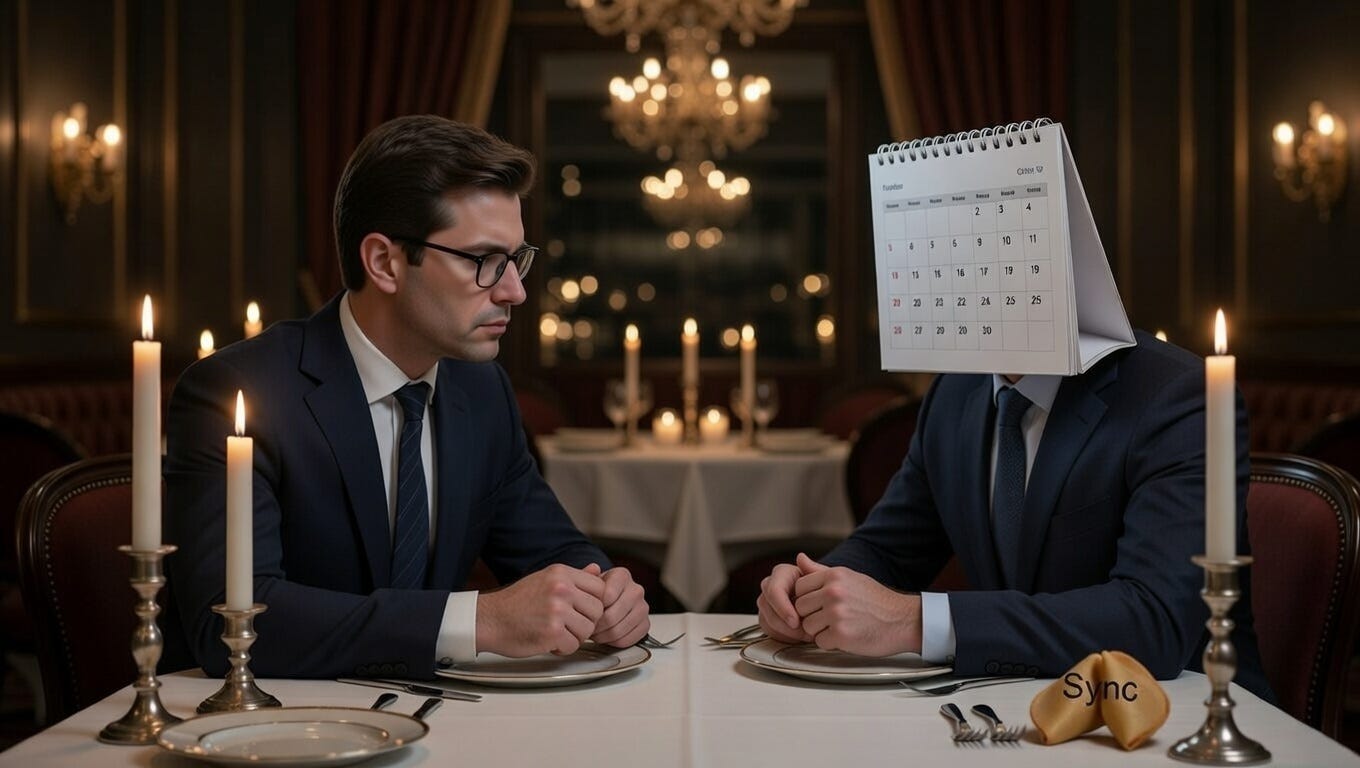
There are few things in corporate life more disorienting than opening your Outlook calendar and staring at this ghost of an entry:
Subject: Discussion (or the classic “Meeting”)
Time: Thursday, 10 a.m.
Attendees: You + the usual suspects + one wildcard from IT who smells faintly of despair
Body: [echoing void]
That’s not an invite. That’s corporate catfishing.
It’s the blind date from a friend who says “Trust me, you’ll click,” then refuses to send a single picture. No bio. No vibe check. Just anxiety and a Teams link.
You spend days wondering:
Is this strategic or tactical?
Am I presenting?
Am I supposed to bring data I forgot existed?
Is this a project update… or an intervention?
You log in half-prepped, fully caffeinated. Organizer smiles: “As you all know…”
No. No, we do not know.
How These Things Happen (The Corporate Amnesia Effect)
These disasters start innocently.
A hallway comment.
A Teams thread.
The final five minutes of another meeting that already ran long enough to qualify as emotional overtime.
“We need to sync on this. I’ll send an invite.”
And they do.
Date. Time. Attendees.
Weeks later, you’re decoding “Sync” like it’s ancient cave art. Sync about what? Scope? Budget? The slow spiritual erosion of the project and my will to live?
Here’s the gut punch: Meetings aren’t free.
Meetings cost money.
Eight people, one hour? Conservatively $400–$600 in fully loaded costs (salaries + overhead). Scale it: employees rack up 10–15+ hours/week in meetings, costing companies ~$29,000 per head annually in payroll time alone (per recent Flowtrace/Archie data). That’s before the billions lost to unproductive ones. We’re green-lighting mini capital expenses with the detail level of a fortune cookie.
Ambiguity isn’t harmless. It’s expensive.
Surprise Is for Cake, Not Calendars
If there’s cake, surprise is delightful.
If there’s no cake, surprise is chaos.

Vague invites deliver predictable disasters:
First 15 minutes: “framing” (recapping the nothing provided).
Middle stretch: reactive tangents because no one prepped.
Last 10: “Let’s regroup.”
Sequel invite drops. Titled “Follow-Up.” Groundhog Day, corporate edition—no redemption arc.
People aren’t disengaged; they’re disoriented. Safe nods. Hedged input. Zero momentum.
The Blind Date Rule (with a Three-Sentence Fix)
Setting up a blind date? You don’t just text “Thursday, 7 p.m., show up.”
You give context: Who they are, why the chemistry might spark, coffee or full-dinner commitment. Enough intel so they arrive ready, not rattled.
Meetings deserve the same respect. You’re borrowing attention, prep time, mental horsepower—not just calendar slots.
The fix is brutally simple. Before hitting send, answer these three things right in the body:
Why are we meeting? One or two lines of context: “Following last week’s hallway meltdown and that email chain from hell, we’re locking scope on Project Phoenix before it grows more heads.”
What output needs to exist by the end? Be explicit: Decision made. Owner assigned. Draft approved. Scope locked. No clear output? Async this sucker.
What should people review/prep? Attach/link the deck, report, or key thread. Highlight the three slides that matter. No ambushing with a 30-pager mid-call like a pop quiz from hell.
That’s the litmus test: If you can’t articulate the why/output/prep, rethink the meeting.
The Leadership Signal (Moving out of the “friend” zone)
Your invites broadcast how you think, how you value time—and people.
Vague ones scream reactivity and calendar anxiety.
Clear ones signal intention, respect, momentum.
When folks walk in knowing the purpose, their role, and what “done” looks like, magic happens: Meetings shorten. Decisions stick. Follow-ups fade. Trust builds because time—the most finite asset—gets treated like it matters.
So next time “I’ll send an invite” bubbles up, pause. Ask: If I got this blank slate six weeks from now, would I walk in confident?
If not, write the extra three sentences. Add the agenda. State the outcome.
Your colleagues won’t throw a parade. They might stop leaving meetings early because the got a text (pre-arranged with a friend to let them escape) with an “emergency”.
But they might stop dreading your chat invites and they might stop bracing themselves when your name appears on their calendar.
In corporate life, that’s basically a standing ovation.
#Meetings #Productivity #Leadership #Teams #CorporateHumor #WorkplaceWisdom